

-
 SHOPPING CART item - 0
| ISBN | 9789386682314 |
| Binding | Hard Bound |
| Pages | XX, 332 |
| Year of Publication | 2018 |
| Language | English |
| Size | 23 cms |
| Subject | Panchayati Raj , Political Science , Sociology |
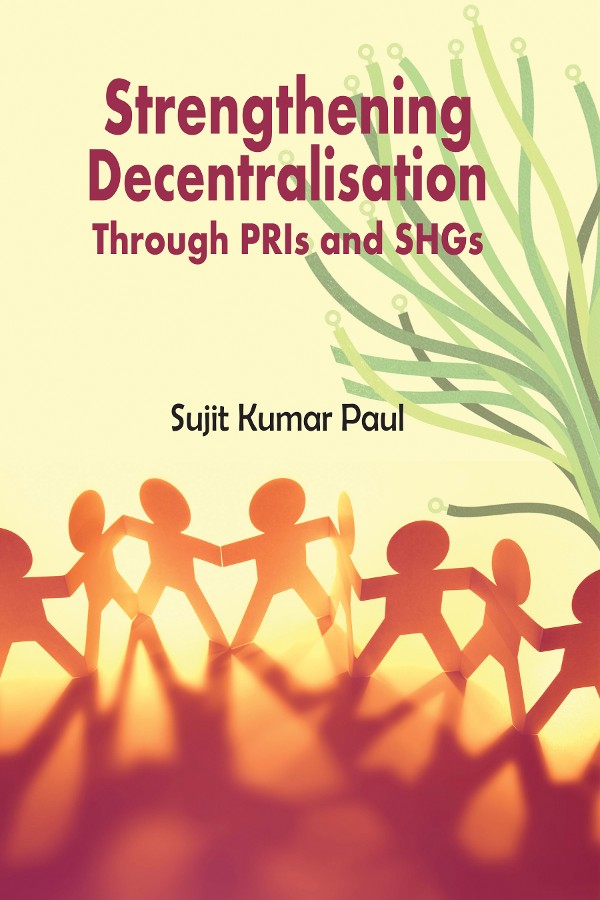
Decentralised governance has been conceived as an instrument of local self-government for promoting healthy and sustainable development. Decentralised governance is assumed to provide more effective and competitive delivery of service at the grassroots level. So, the enormous and growing discussions on decentralisation have attracted the attention of scholars and policy-makers all over the globe.
The present book attempts to cover diverse aspect of decentralisation process covering diverse issues and experiences connected with Panchayati Raj Institutions and Self-Help Groups. The book attempted to provide a holistic picture of the decentralisation process with a special reference to Panchayati Raj Institutions and Self-Help Groups. The book contains both theoretical and empirical aspects of decentralisation, PRIs and SHGs. This book will be an invaluable guide to the students, researchers, teachers, academicians, development workers, planners, policy-makers and various development organizations interested in local self-governance and decentralised planning.
Sujit Kumar Paul is working as a Professor of Rural Development and Management in the Department of Lifelong Learning and Extension, Visva-Bharati (A Central University and an Institution of National Importance), Santiniketan, West Bengal, India. Prof. Paul is engaged in teaching, research and guiding PhD scholars. As prolific writer, he has published more than 100 research papers in the national and international journals of repute. He authored eleven books on various development issues. He also edited four issues of the International Journal of World Education, published by the AWE (International). He is closely associated with various government and non-government organizations, societies and associations in different capacities. Prof. Paul is the AWE UN Representative and has been serving as Vice-President of AWE International – an international organization that holds “Consultative Status” with the Economic and Social Council (ECOSOC) in the United Nations for the last twenty-two years.


