

-
 SHOPPING CART item - 0
| ISBN | 9789386682611 |
| Binding | Hard Bound |
| Pages | 1172 |
| Year of Publication | 2019 |
| Language | English |
| Size | 25 cms |
| Subject | Geography , Reference Work , Sociology , Urban Studies |
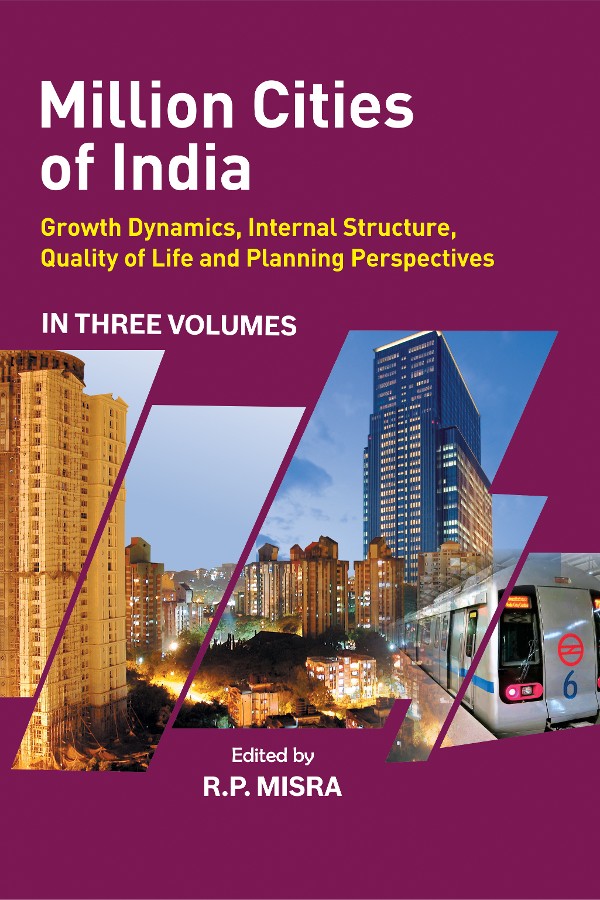
The first edition of Million Cities of India was published in 1978. It was based on 1971 Census returns. At that time, there were only 9 Million Cities: Calcutta, Bombay, Delhi, Madras, Hyderabad, Ahmadabad, Bangalore, Kanpur and Poona. The second edition of the book was published in two volumes in 1998 using 1991 Census data. By that time the number of cities with a million or more population had increased to 23. By 2001, it went up to 35 and by 2011 to 53, and is likely to go up to 70 by 2021.
The first edition of the book was published by Prasaranga, University of Mysore in 1978. Prof. R. P. Misra, the editor of the book at that time, was the Director of Institute of Development Studies, University of Mysore, Mysuru, Karnataka. And the second edition of the book was published in 1998 in two volumes by Sustainable Development Foundation, New Delhi.
This is the third edition of the book and is based on 2011 Census returns. It covers 53 Million Cities as reported by Census of India and 8 de facto Million Cities which formed Urban Agglomerations (UAs). UA was an extended city comprising the built-up area around a major city provided that the extended areas were located within the same state. For example, Noida, Greater Noida, Ghaziabad, Gurugram and Faridabad are functionally parts of Delhi but they are outside the Union Territory of Delhi and hence not included in Delhi UA. If they are considered as part of Delhi UA, the 2011 population of Delhi would go up to 21.7 million. Thus the population of all the cities of Kerala got inflated and they cannot be compared with other cities of the country in this respect.
In all, there are 53 million cities in India as per Census of India 2011. The First Volume has twenty chapters. Chapter 1: Introduction introduces the contents of the volume to the reader. Chapters 2 to 6 present the global urban scenario as reflected by the relevant UN agencies; urban history of India from ancient to most recent times; contemporary urban scenario as reflected by 2011 Census returns; the urban development Missions, Programmes, Projects and Schemes launched by the Government since 2005 such as JNNURM, AMRITA, Smart Cities etc. to make Indian cities meet the needs and aspirations of the people; and India's urban future that calls for integrated development of rural and urban areas. The remaining 14 chapters focus on cities which had more than 2.5 million population in 2011.
The Second Volume contains twenty-two chapters each covering cities in the population range of 2 to 1.3 million. The order in which the chapters of the book are arranged is the same as in Volume I, i.e. the size of the population of the urban agglomerations (UAs) in 2011. The volume has chapters on each of the 22 Million Cities of India having population in the range of 1,200,000 to 2,167,447, in 2011.
The Third Volume covers 23 cities whose population ranges between 1250,000 and 900,000 and includes cities like Bhubaneswar-Cuttack, Gurugram, Mysore, Guwahati, Sholapur and Hubli-Dharwad, which are de facto million cities but the Census of India 2011 does not include them in the list of million plus cities.
Born on 18 January, 1929, Prof. Rameshwar Prasad Misra (R.P. Misra) is an internationally known Geographer, Regional Planner and Gandhian Scholar. He did his M.A. (Geography) at Allahabad University in 1954; M.A. (Economics) at DBS Post-graduate College affiliated to Agra University in 1960; and Ph.D. at University of Maryland, College Park, Md. USA in 1964. He made a name in development circles as founder Director, Institute of Development Studies (IDS), University of Mysore (1965-1979) and worked as Consultant Advisor at the United Nations Research Institute for Social Development (UNRISD), Geneva (1971-72); and UNDP, Teheran, Iran (1974-75). He was Vice-director, UN Center for Regional Development (UNCRD), Nagoya, Japan (1979-84). Among the countries, he went on UN advisory missions are: Bangladesh, Indonesia, Philippines, China, S. Korea, Iran, Tanzania, Kenya, Nigeria, Brazil and Mexico. He returned to India as Vice-Chancellor of Allahabad University (1984-87) and then moved to Delhi University (1987-95) as Professor of Regional Planning, and Director/Chairman, Center for Gandhian Studies and Peace Research.
Prof. Misra has been honoured with Golden Jubilee Award by Mysore University for Best Research Publication (1968); Dr. Zakir Hussain Chair Professorship by University of Mysore; Scholarly Achievement Award by the Institute of Oriental Philosophy, Tokyo (1992); Life Time Achievement Award in Ecology and Environment by Commonwealth Human Ecology Council (1998); Bhoogol Ratna Award for Life Time Achievement by the Bhoovigyan Vikas Foundation, New Delhi (2002); and the first Mahatma Gandhi National Fellowship (2001-03) by the Ministry of Culture, Government of India. He has more than 80 books and 200 research papers to his credit. Among these publications are: 10 volumes-series on Regional Development, 5 volumes-series on Rual Development, and 10 volumes-series on Mahatma Gandhi.
E‑mail: sdf.misra@gmail.com


