

-
 SHOPPING CART item - 0
| ISBN | 9789355946737 |
| Binding | Hardbound |
| Pages | XX, 156 |
| Year of Publication | 2024 |
| Language | English |
| Size | 23 cms |
| Subject | Anthropology , Ayurveda and Health Sciences , North East Indian Studies , Sociology |
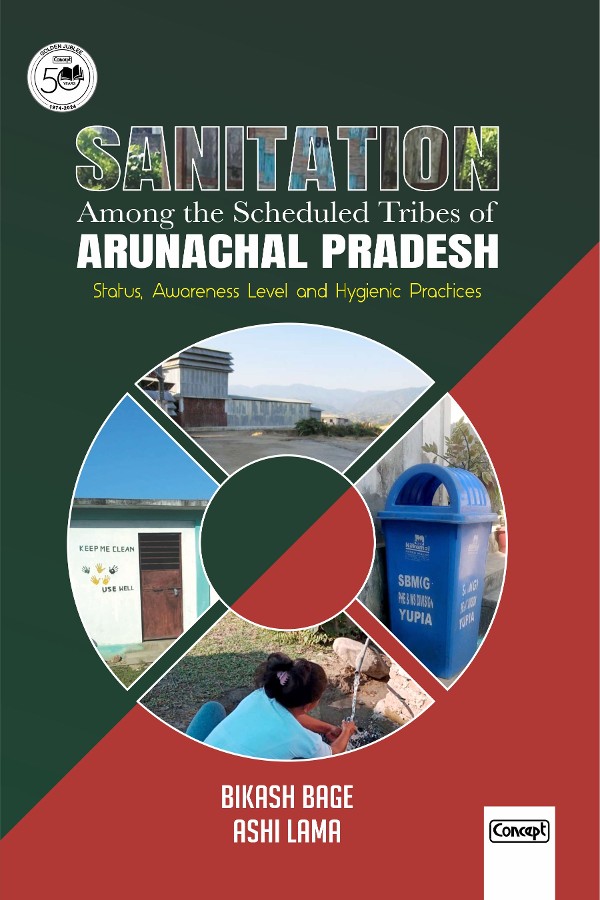
This book is based on the outcome of the research project funded by Ministry of Social Justice and Empowerment and Ministry of Tribal Affairs, Government of India. The project was supported by the Department of Social Justice, Empowerment and Tribal Affairs, Government of Arunachal Pradesh. Sanitation is vital for ensuring a healthy and productive life of the people. Recognising the importance of sanitation, the United Nations has declared ensuring access to safe water and sanitation as one of the 17 goals of sustainable development. Government of India aims to achieve open defecation free India and tap water supply to all households. However, a large number of tribal people do not have access to proper sanitation facilities and safe drinking water. Tribal population consists of around 8 per cent of India's population. Access of tribal population to safe source of drinking water and sanitation has been inadequate for several years. So, the book deals with the status of sanitation among the tribal people of Arunachal Pradesh. It also explores the level of awareness, sanitary habits and hygienic practices among the tribal people of the State. Sanitation and sanitary practices among the tribal people have improved due to government intervention in the form of Swachh Bharat Abhiyan. The book shows that there has been significant improvement in access to sanitation among the tribal people in the State in terms of coverage. But in terms of quality, progress in sanitation has been inadequate. Further, there is a scope for improvement in awareness, sanitary habits and hygienic practices among the tribal households.
Dr. Bikash Bage is a Professor and Head in the Department of Sociology, Rajiv Gandhi University, Arunachal Pradesh, India. He is the Nodal Officer of the Tribal Research Institute (TRI), RGU, funded by the Ministry of Tribal Affairs, GoI, and in addition, a member of various state-level policy-making committees in Arunachal Pradesh. In 2025, he served as the Chairman of the Multidisciplinary Expert Group on Social Impact Assessment of Major Hydroelectric Projects in Arunachal Pradesh. He is a Life Member of the Indian Sociological Society (ISS), a Member of the International Sociological Association (ISA), and a Member of the Asia Pacific Sociological Association (APSA). He is the Founder-Chief Patron of Arunachal Sociological Forum (ASF), established in 1999. Prior to his present academic profession, he served for about 10 years as Deputy Director under the National AIDS Control Organisation, Ministry of H&FW, GoI.
He has authored/edited 10 books and has developed as many as 8 textbooks at the Centre for Distance & Online Education, RGU. As the OSD, he is the recipient of the Arunachal Pradesh and Nagaland State Governor's Recognition on outstanding academic contribution for the trifurcation and creation of the Directorate of Family Welfare and the Directorate of Medical Education, Research & Training from the erstwhile Directorate of Health Services, under the Department of Health & Family Welfare, Government of Arunachal Pradesh.
Ashi Lama is an Associate Professor in the Department of Economics, Rajiv Gandhi University. He has to his credit more than 35 research articles published in reputed and refereed Journals and edited books. He has published one authored book, two edited volumes and two working papers. He has also presented a number of research papers in various national and international conferences. He has also carried out more than 10 Research Projects funded by Government of India, Government of Arunachal Pradesh and other funding agencies like Indian Council of Social Science Research, UGC, Centre for Development Studies, Rajiv Gandhi University and ICRIER, New Delhi.


