-
 SHOPPING CART item - 0
| ISBN | 9789355946225 |
| Binding | Hardbound |
| Pages | XXVI, 366 |
| Year of Publication | 2025 |
| Language | English |
| Size | 23 cms |
| Subject | Hills and Himalayan Studies , North East Indian Studies , Sociology , Geography |
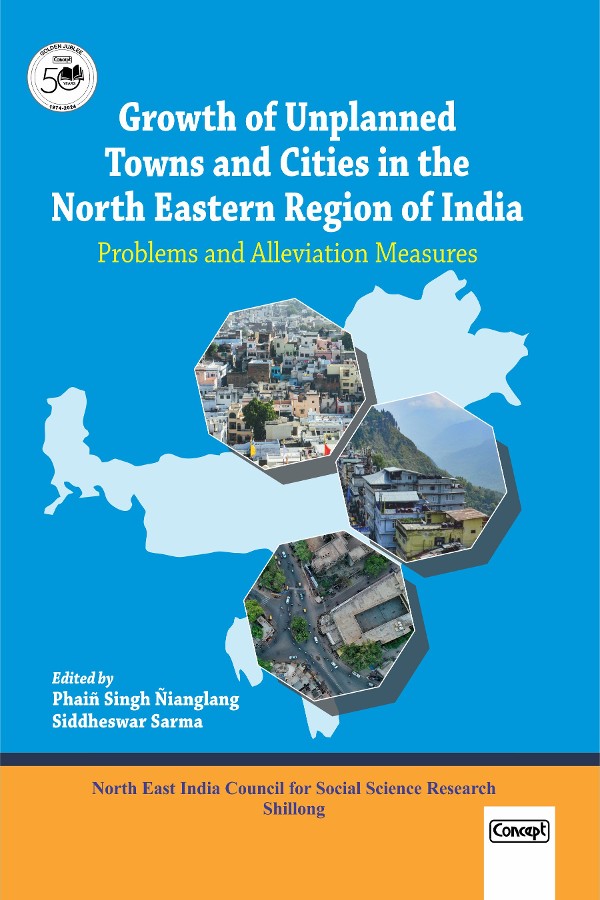
Town planning is the process of managing land resources. It involves the control of existing and new developments, as well as strategy preparation to ensure manage future requirements. It is designing and managing the physical, social, and economic development of cities, towns, and other urban areas. Most of the cities and towns in India, especially in the hills came into being unplanned, thus lack proper civic facilities and amenities.
As the title suggests, this book presents the pros and cons of unplanned cities and towns of NER of India. Substantially a collection of articles, contributed by different professionals and experts on the theme, this book is organised in two parts. Part-A focusses on urban sprawl, cable cars, land suitability analysis for master plan, urban safety in road design, secured livelihood and empowerment of women street vendors, goods movement pattern and distribution, traffic decongestion measures etc. Part-B encapsulates the topics like waste management, centripetal and centrifugal urbanisation in tribal habitats, unplanned growth, issues pertaining to slum-dwellers, and urban growth and environmental consequences, spatio-temporal dynamic patterns of urban centres, town morphology, road accidents and safety measures, and urban housing demand.
Definitely, the vital information based on empirical studies, contained this volume will delight and enlighten one and all concerned.
Phaiñ Singh Ñianglang D.C.E, M.A, M.Phil, Ph.D, A.I.T.P. (India); born on 22.09.1962 served in different capacities in the MGCC Ltd, Government of Meghalaya and in the North Eastern Council, Shillong. He attended the short-term trainings and workshops in the country and abroad. He superannuated as a Chief Planning Officer & ex-officio Joint Secretary in the Planning Department. He qualified in town planning from the Institute of Town Planners, Delhi. His thesis on urban traffic decongestion measures was supervised by Dr. Sanjay Gupta, Professor of Transportation Planning, SPA (Delhi) and Mr. Sazidul Alam, Joint Director, Urban Affairs, Government of Meghalaya as the official adviser. His areas of interest are systems theory in town planning, town planning techniques and urban transport planning.
Siddheswar Sarma, M.Sc., M.Phil., Ph.D., started his service career as a Lecturer in the Department of Geography, Arya Vidyapith College and subsequently in B. Barooah College, Guwahati. Being a trained geographer in Remote Sensing and GIS from Indian Institute of Remote Sensing, Dehradun and NRSA, Hyderabad, he has completed three projects based on remote sensing techniques sponsored by the Planning Department, Science and Technology Cell, Government of Meghalaya. He is the author of two books on Meghalaya and co-editor of four books. Presently he has been engaged as Counsellor and Supervisor of IGNOU, Shillong Study Centre. Besides attending 48 national seminars and conferences in the country, he also organised 11 national seminars and three international seminars. He has been serving as the Secretary, North East India Council for Social Science Research since 2008.