

-
 SHOPPING CART item - 0
| ISBN | 9788170223993 |
| Binding | Hard Bound |
| Pages | 184 |
| Year of Publication | 1992 |
| Language | English |
| Series | Concept |
| Size | 23 cms |
| Subject | Agriculture , Environmental Science , Geography , Hills and Himalayan Studies |
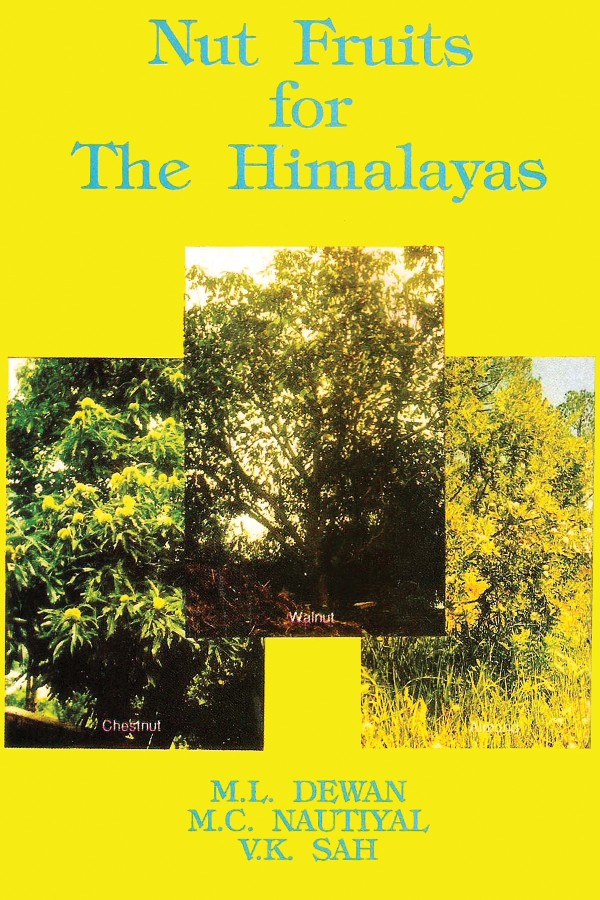
The genesis of the book Nut Fruits For The Himalayas rose in the mind of the authors some years back while dealing with the problems of Central Himalayas. Walnuts were there, but sporadically in certain parts. The new high yielding varieties and superior clones were not available to people. There was a question in the minds of many rural people whether almonds and chestnuts would really work in these parts. The most important element was when you would see perishable and semi perishable fruits bearing hardly any income to the farmers in spite of their efforts and even sometimes expenses. The middleman would persuade sellers of the fruit that if they did not sell at the middlemen prices they were bound to lose everything. Non-perishable fruits which are essentially nut fruits came into prominence as a result. Trees For Life, sponsored many eco-development efforts in tree planting and protection. One such effort with a great degree of success was where walnuts and other nut seeds were brought from the Banihal area in Jammu and Kashmir. Additionally, sweet chestnuts from Pithoragarh are being tried in many areas. There was inadequacy of knowledge and experience in these nut fruits for the farmers and other Orchardists not only about these three nut fruits but others also. It was with this background that our Team of three, myself with Prof. Nautiyal and Dr. Sah worked on this document. The Chapters are organised according to Nuts: 1. Walnut; 2. Almond; 3. Chestnut; 4. Hazelnut; 5. Pecannut; 6. Pistachio Nut; 7.Chilgoza Pine Nut; 8. Apricot; 9. Cheura; 10. Macadamia Nut; 11. Minor and Multi-purpose nuts suitable for the Himalayas. Major information such as climatic requirement, Soil requirement, propagation including seed and vegetative propagation, Planting time, Training and Pruning, Manuring time of Flower and Fruit setting, Diseases and insect pest management on each of the nuts is given in the text. It is hoped that this information which is also being translated into Hindi will serve the people of the Central Himalayas and Himachal Pradesh, and even J & K. It is hoped that the readers, especially Horticulturists and Orchardists will give some attention to these nut fruits for the benefit of the rural people. A training programme was conducted in Winter 1990-91 for proper planting of walcuts, almonds and chestnuts. The walnuts and other nut trees have been coming up well in nurseries in large numbers in various parts of Central Himalayas and it is hoped that they will be planted in suitable places during the coming winter season 1991-92 and subsequently such as Programme is expected to bring in Nut Revolution in the Himalayas. Suggestions, views, advice and experiences are welcome from the readers.
Madan Lal Dewan (Ph.D., Cornell), a well-known Soil Scientist, started work on soil conservation in Damodar Valley Corporation during 1949-52. He had a distinguished career with Food and Agriculture Organisation for over three decades (1953-83). He worked as Chief of the FAO Regional Bureau for Asia and the Pacific. He had FAO assignments in Iran and Bulgaria and was at FAO Headquarters in Rome for 14 years. Dr. Dewan was visiting Professor and Co-ordinator of Himalayan Eco-System Programme with Centre for Policy Research, New Delhi. He was a member of the National Land Use and Conservation Board of Government of India during 1984-87. He is founder Chairman and Trustee of Himcon and has established a Centre Himalaya Sanrakashan Ashram at Ranichauri, District Tehri Garhwal, Uttarakhand. Soil of Iran, Soil Conservation of Iran, Agriculture and Rural Development in India, Peoples Participation and Rejuvenation of Himalayan Environment and ten other books are amongst his published works, in addition to more than 100 papers on various aspects of soils, soil conservation, land and water development.
M.C. Nautiyal received his Ph.D. in Horticulture from the U.P. Institute of Agricultural Sciences, Kanpur, in 1976. He has served several Government and semi-Government organizations and is currently working as Senior Scientist (Horticulture) at G.B. Pant University of Agriculture & Technology, Hill Campus, Ranichauri, Tehri Garhwal, U.P. During his 20 years experience in the field of horticulture, he has contributed in developing the improved orchard management systems for the Himalayas. He has successfully piloted the project ?Expansion in the area of fruit trees through exploitation of indigenous species sponsored by the Department of Environment, Government of India. He was assigned to DPR of Korea during 1989 on deputation mission under the Indo-DPRK Work Plan 1988-89. Dr. Nautiyal has more than 80 publications of national and international repute to his credit. His writings reveal rich experience.
V.K. Sah obtained his D. Phil. from Garhwal University, Srinagar, in 1982. His field of study has been the inter-relationship between temperate vegetation and Himalayan eco-system. Currently he is giving consultancy service to the voluntary organizations and the peasantry of the Himalayan Zone, with special reference to nursery management techniques for forest species of economics and social importance. He has over 20 research papers to his credit.


