

-
 SHOPPING CART item - 0
| ISBN | 9788170220442 |
| Binding | Hard Bound |
| Pages | 136 |
| Year of Publication | 1986 |
| Language | English |
| Size | 23 cms |
| Subject | Sociology |
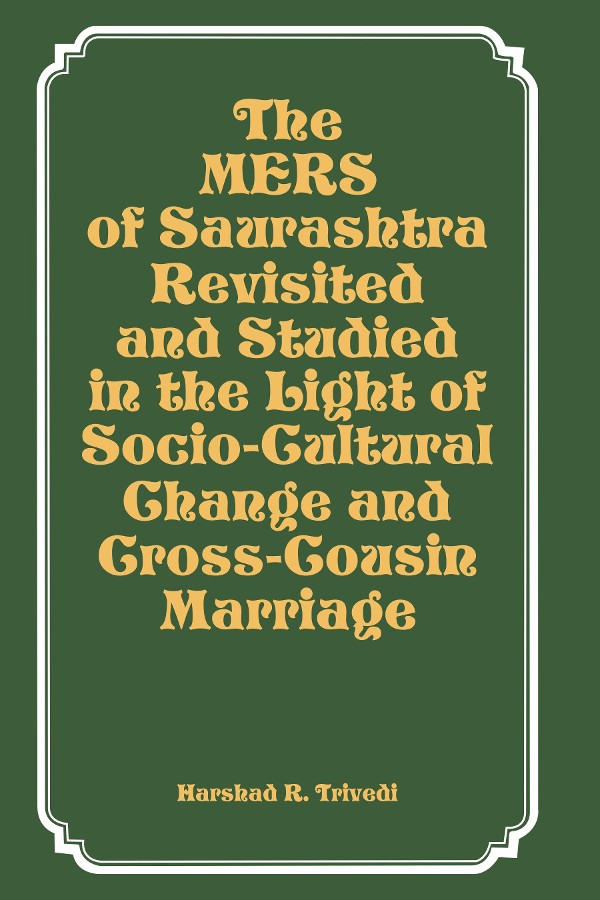
The focus of the study is socio-cultural change and the present state of cross-cousin marriage among the Mers of Saurashtra after thirty years of Revisit Assessment of the situation by the author. Dr. Trivedi interprets the Mer data on the basis of new theories and concepts used recently in anthropology. The cognitive theory, etic, emic, concepts and mechanical and statistical models of changing social systems have been used for analysing and interpreting the data. Unlike the initial study which was largely descriptive, the present one is highly analytical and interpretative. A fairly condensed treatment is given to the field-data.
In contrast to external changes taking place rapidly in dress, manners, housing, and adoption of new technology, the social structure and organisation of the Mers have remained almost unaffacted. The two sided cross-cousin marriage system is nearly intact. This system of marital unions is being practiced in Saurashtra among the Ahirs and Kathis. Moreover, some groups of Bhangis in Central Gujarat, and South Gujarat tribes such as Gamits and Warlis also practice bilateral cross-cousin marriage.
The salient feature of the study is that it deals with the impact of ecology and technology on Mer society. Besides, it reveals that the cross-cousin marriage is to be found in parts of India, Oceania, Africa and some regions of ancient world also. The specific critical problems met by Dr. Trivedi, with dialectical approach, include (i) theoretical issues and intragroup perspectives of Mer kinship organisation, (ii) regional perspectives of kinship organisation, (iii) historical and theoretical dimensions of cross-cousin marriage, (iv) overall impact of socio-economic change on social structure and (v) futuristic view of Mer society and the system of cross-cousin marriage.
The book submits a uniqe forecast propounded by the author: “If by chance, a large part of humanity is destroyed after the impending nuclear war, it will be the mechanism of bilateral or symmetrical cross-cousin marriage, I think, that will rescue man from extinction and shall be most helpful in preserving and perpetuating the human species and in creating a sane society out of the scattered groups of people hopelessly surviving somewhere on earth.”
Harshad R. Trivedi was born (1923) in the village of Hariana in the Jamnagar District of Gujarat State (India). His student life was spent in Baroda where his family migrated during his childhood. He received Ph. D. Degree in 1955 from the M.S. University of Baroda, Department of Sociology under Prof. M. N. Srinivas. Subsequently, be worked among the Dubla Halpati and Naika tribes of South Gujarat for about a year in the Tribal Research Unit of Gujarat Research Society of Bombay.


