

-
 SHOPPING CART item - 0
| ISBN | 9788170226437 |
| Binding | Hard Bound |
| Pages | 185 |
| Year of Publication | 1997 |
| Language | English |
| Size | 23 cms |
| Subject | Agriculture , Economics , Energy , Geography , Science and Technology |
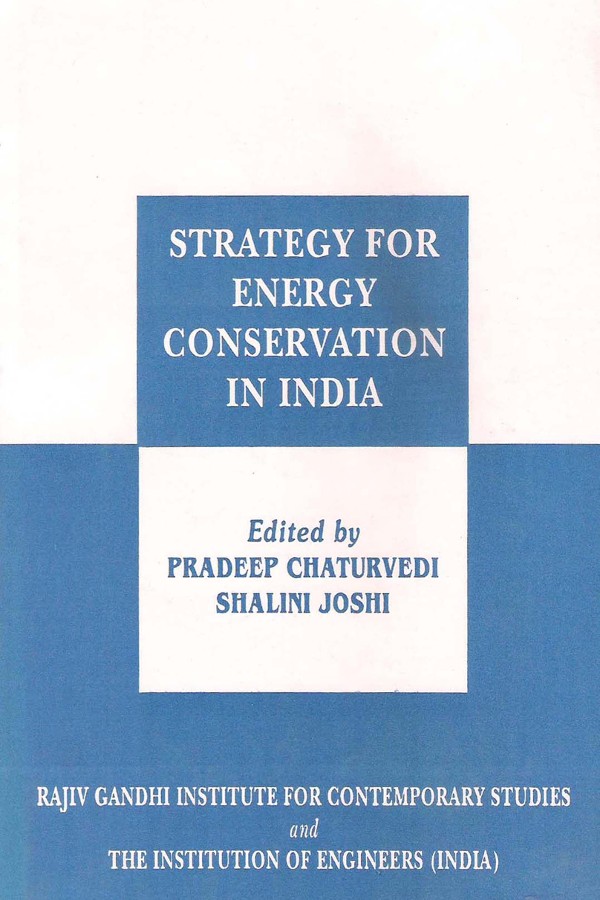
Energy Conservation is gaining significance in the Indian context as the governments efforts over the last five years to encourage private and foreign investments in the power sector has not brought in desired results. Government has planned additional capacity as well as energy conservation as two pronged approach to fulfil the energy needs of the growing economy during the Eighth Five Year Plan. The thrust, however, had shifted towards promoting higher capacity installation, and therefore, the energy conservation sector was neglected. Midway of the Eight Five Year Plan When it was observed that foreign and private investments were not coming forward at the desired pace, concern was expressed about conservation efforts. Monitoring and evaluation of national programmes obviously comes through professional and social organizations. The Rajiv Gandhi Institute for Contemporary Studies, Rajiv Gandhi Foundation and the Institution of Engineers (India) organized a National workshop on Energy Conservation during September 1995 involving policy-makers, industrialists, energy experts and economists to discuss the impact and to decide on future approach for effective energy conservation method. The Participants strongly supported the need for privatizing energy conservation in the country as the investment required for energy conservation is far less than for additional capacities. The key to future cost-effective energy supply system lies in consideration of the final energy rather than the primary needs of the country. In this respect energy efficiency also has to be focused. India needs, to develop a three-tiered conservation strategy; first tier will include good management practices and proper house keeping; the second tier will include moderate technology interventions and the third tier will include total changes in equipment, technology and processes. The movement can only catch on if the measures suggested are within the investment capabilities of the user industries and the capital market. A need was also felt to focus attention on the energy producing sector which has its own technical and financial capability. The book is a compendium of paper presented at the workshop.
Pradeep Chaturvedi, Chairman of the Institution of Engineers (India), Delhi State Centre is a Mechanical Engineer and an energy and environment expert. He has been involved with sustainable development issues, mainly the energy policy and planning and implementation of environment friendly sustainable energy projects for over three decades in India and other Asian and Pacific countries. As a Member of the Perspective Planning Group of Planning Commission, preparing Development Vision 2020, he contributed 'India's Energy Vision 2020'. He has been actively involved with the formulation of Energy Conservation Act 2001 and the Electricity Bill 2001. Mr. Chaturvedi has been involved with the Studies Programme of the World Energy Council since 1983. His understanding of energy issues of the South Asia Region, in the global context, has been widely appreciated. Mr. Chaturvedi was deeply involved with the preparatory phase of the World Summit of Sustainable Development. He is also involved in the follow-up phase. Mr. Chaturvedi is Vice-Chairman of the UNESCO sponsored World Renewable Energy Network; and Vice Chairman of the World Environment Foundation, both based in UK; and President of the Bio Energy Society of India. He is also a Visiting Faculty at IIT, Delhi. Mr. Chaturvedi has authored six and edited 25 books on Energy Management and Sustainable Development. These books are widely referred to understand the situation in the country.
Shalini Joshi is a Project Officer at the Rajiv Gandhi Institute for Contemporary Studies.


